
A Flawed Film, Not an Invalid Supergirl

Yesterday, I saw and enjoyed Supergirl. I didn’t love it and saw its flaws clearly, but I remain baffled by the hostility it has generated among some comic fans and the easy dismissal it has received from mainstream critics.
On paper, the film had all the right credentials for success: a best-selling, well-regarded graphic novel as its source material, Craig Gillespie (I, Tonya) behind the camera, and a script from Ana Nogueira (Which Way to the Stage). Milly Alcock went from a beloved figure in House of the Dragon to the Maid of Might, so she had some fan backing. Apparently, though, not enough. Some of the reaction to her casting seemed less about the performance than about whether she fit a narrow, traditional image of comic-book beauty, and that brought out the darker side of comics fandom.
Which Supergirl Are We Talking About?
A lot of the hue and cry over the film, and over Supergirl in particular, came down to the complaint that the movie didn’t represent their Supergirl. I’ve been reading comics for almost as long as she has been around, and my question to those complainers is simple: Which Supergirl? Between her debut and today, she may have had more tones, takes, and personalities than almost any other hero in the DC Universe.
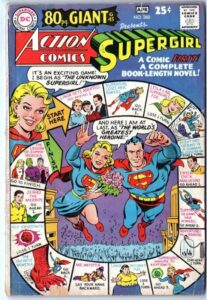
Throughout the Silver Age, Supergirl was largely a younger, female version of Superman, with her backup stories in Action Comics offering fanciful tales designed for pre-teen female readers, hence all the romance. When editor Mort Weisinger retired, she was handed to incoming writer/editor/artist Mike Sekowsky, who set her on several career paths and put her through many different costumes. She went from student to soap opera actress to whatever else the moment required. Her Bronze Age stories, mostly from Paul Kupperberg, were largely about derring-do and not much about character building.
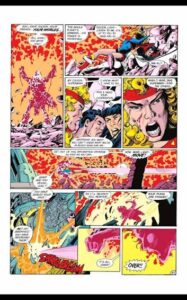
After the 1984 film bombed, DC Publisher Jenette Kahn gave the okay for her death in Crisis on Infinite Earths. It was a wonderful, noble, heroic death.

The next iteration was Matrix, a being from a pocket universe created from Lana Lang’s DNA, who came to the DCU as Supergirl and operated as such until she merged with Linda Danvers and was reborn as an Earth Angel in the well-respected Peter David and Gary Frank run.
Other fans loved the Jeph Loeb and Michael Turner reintroduction of the heroine, this time as someone sent as a teen to arrive before Kal-El. Her ship got into trouble, however, so he was already Superman by the time she reached Earth. She carried a serious attitude, sharpened by training with the Amazons of Paradise Island.
Not much happened during the New 52 era, but the DC Rebirth version owed more to the CW television series than to what came before in the comics.
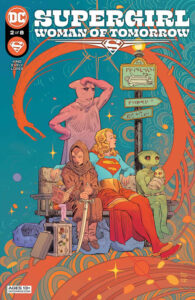
That brings us to Infinite Frontier and the film’s source material. Many people didn’t like Woman of Tomorrow, written by Tom King and lushly illustrated by Bilquis Evely. They didn’t like this take on Kara Zor-El, but it was fresh and, more importantly, logical.

Few writers had seriously considered what a teenager would feel after being sent away from her dying home, or what trauma that would leave behind. This was a woman in pain. She didn’t want to be the beacon of hope her cousin was. She didn’t want to be a role model. She just wanted the pain to stop.
The DC All In version from writer/artist Sophie Campbell is more of a modern-day version of the old Silver Age stories and features a pleasant but bland Supergirl who doesn’t always mesh with her appearances elsewhere.
The Movie’s Take on Kara
That brings us to the movie, which is essentially a coming-of-age story for Kara Zor-El. She is turning 23 and has been masking her pain by traveling to worlds orbiting red suns, where she can feel alcohol, dance music, and the physical consequences of bar fights. She is adrift, unsettled on Earth, and aimless despite her cousin’s patient understanding.

When she encounters young Ruthye Marye Knoll (Eve Ridley), things start to change. Krem of the Yellow Hills (Matthias Schoenaerts), leader of the Brigands, has been stealing young women to serve as brides and breeders for his dying race. He lands on Ruthye’s homeworld, kills her parents and brother, and steals two well-crafted swords that are oddly never seen or used again in the film.
Ruthye has been tracking Krem and wants vengeance, which Kara finds amusing, as does Lobo (Jason Momoa). Krem is looking for a way off planet after his ship is destroyed, so he steals Kara’s ship and shoots Krypto with a lethal poison. Kara is now caught up in the fight against her will, all to get the antidote, which only Krem seems to carry around his neck, in plain sight, no less, within three days.
Where the Script Falls Short

Much has been said about the film’s homages to classic Westerns, and more could have been done with that concept. Many of the film’s problems, though, come down to a script that has interesting ideas but fails too many of its characters.
Kara is suffering, yes, but we feel that most strongly only during the flashbacks to her life on Argo City before radiation began killing its population and she was sent away to live with her cousin. She’s a mess. She loves her dog. She avoids Clark (David Corenswet). But until she embraces her true nature, she is not always as compelling as the film needs her to be.
Ruthye is not Matty from True Grit, but she fills a similar role. She is eloquent and brave, ready to get involved, yet she is rarely given the chance to do something meaningful. Instead, she is repeatedly told to stay put, which she never does. Late in the story, she is shown to be her father’s daughter, sword fighting with skill, but that beat needed to be established earlier.

Krem is neither charismatic, charming, nor especially interesting; he resembles too many other alien villains from other science-fiction films. Trying to save his people is an intriguing motivation, even if we detest the methods he employs, but the film does little with it. His followers are treated as little more than cannon fodder. He also carries kryptonite weapons, which make little sense given what has been established in the new films to date.
Ruthye plays Jiminy Cricket, which is essential for Kara’s growth. What feels totally nonessential and largely wasted is Lobo. Remove him from the film, and the story still works, which makes one wonder why there was such a rush to introduce him now.
There are other story-logic issues, and the pacing is uneven. A mammoth bar fight is effectively replicated for the finale, and neither sequence offers much beyond mayhem.
Why It Still Works for Me
Criticisms aside, I liked the film more than this may suggest. Alcock makes a fine Kara and could become a major female role model for today’s youth: messy, wounded, imperfect, but with her heart in the right place.
The Box-Office Narrative
The budget, estimated as high as $180 million before marketing, means the film likely needs to clear roughly $600 million to be seen as profitable. As of today, it stands at approximately $100.5 million, falling far short of expectations. When the opening weekend numbers came out, it was immediately declared a flop or a bomb, and the media began reporting how much Warner Bros., caught up in an ugly merger with Paramount, stood to lose, with estimates as high as $125 million.
We have recently learned, thanks to The Hollywood Reporter, that the released film is not the director’s original vision but a studio version that tested two points higher. Were all the reported points of contention accurate? We’ll never know; we weren’t there. But when a studio interferes this way, the finished product often suffers.
Still, it is all tangled up in Hollywood accounting because the numbers do not reflect ancillary sales from toys to Happy Meals. So, is it really a complete flop? Probably not. But it is most certainly a disappointment for Warner Bros., James Gunn, and Peter Safran. The larger disappointment, though, is that a flawed but interesting attempt to rethink Supergirl has been treated by some as an invalid version of a character who has never had just one valid form.
If Supergirl has taught us anything across all these decades, it is that reinvention is not a betrayal of the character; it is the character’s inheritance.
#Tags: Action Comics, Ana Nogueira, Bilquis Everly, Craig Gillespie, Crisis on Infinite Earths, CW, David Corenswet, Eve Ridley, Gary Frank, House of the Dragon, James Gunn, Jason Momoa, Jenette Kahn, Jeph Loeb, Lana Lang, Lobo, Matrix, Matthias Schoenaerts, Michael Turner, Mike Sekwosky, Milly Alcock, Mort Weisinger, New 52, Peter David, Peter Safran, Sophie Campbell, Supergirl, Superman, The Hollywood Reporter, Tom King, Woman of Tomorrow
I wasn’t particularly happy with the introduction of Milly Alcock’s Supergirl at the end of James Gunn’s SUPERMAN film, but I actually liked it here. While I hadn’t previously considered it, Supergirl’s 1950s origin/introduction really makes no sense, as Kara arrives on Earth cheerful and happy immediately after her parents and everyone she knew just perished on Argo City. The contrast between Kara and Kal-El in this new DC cinematic universe makes much more sense, since Clark has no actual memory of his Kryptonian parents and had a pretty happy childhood growing up with the Kents in Kansas. I appreciate the fact that Supergirl is no longer merely a distaff clone of Superman but a more complex character whose personality pretty logically emerges from her own personal dark history.
I liked the movie, too (I actually liked it better than Superman 2025). I also think the criticism of the film has been downright histrionic and over-the-top, but this is what I think is driving the negative reaction:
1. The Hollywood trade press was waiting to take James Gunn down a peg. Since he’s been in charge of DC Studios, Gunn has been indifferent to the trade press (using his Twitter account to bypass the trade papers) or downright hostile (aggressively going after the papers when they report on casting scoops that he doesn’t want revealed, all but accusing him of lying). So the scathing review that Variety gave to the film, as well as the takedown expose in The Hollywood Reporter that you mentioned were likely deliberate hit pieces to put him in his place. I’ve never been a huge fan of Gunn or his work, so I think he brought this one on himself.
2. The “not my Supergirl” reaction. As someone who is an unapologetic fan of Zack Snyder’s Justice League Trilogy (I’m a Gen-Xer who grew up in the ’80s, so those three films (plus the first WW film) are the closest approximation to the mid-1980s post-Crisis reboots that DC was doing at the time, which I loved and continue to love), I’ve been to this rodeo before. For whatever reason, the DC brand seems to attract fans who believe that there is only one, pure interpretation of the DC characters–which just so happens to be the version of the characters that each of these fans individually prefers, regardless of the fact that each of these preferred versions is completely different from one another (back in 1989, Michael Keaton referred to an early cohort of these fans as “DC Comics fundamentalists,” and I think the label still applies). Instead of evaluating these films based on what the filmmakers were trying to achieve, this cohort of the audience is evaluating the films based on what *they* (the audience) thinks the films *should have* been. And that’s an impossible metric for any artist to meet. This was the same mentality that turned vitriolic toward the Snyder DC films, particularly after BvS, and now its being weaponized against Gunn’s version of these characters. Personally, even though I have preferred interpretations of these characters (Zack Snyder’s take and the ’80s post-Crisis comics), I’m also ecumenical in liking and welcoming many different versions of the DC Universe.
3. I think this may be a generational issue, but a lot of people who turn on these DC films (e.g., Supergirl, BvS, Superman Returns) don’t seem to understand how melodrama and narrative structure works. They want these characters to forever and always be perfect and flawless. But as anyone who understands drama knows, characters need arcs. They need challenges to overcome. And so, for me, a depressed and despondent Supergirl coming out triumphant at the end of the movie is simply Character Development 101 (the same with Ben Affleck’s Batman playing the Judas role in BvS only to become St. Paul in JL in the Jesus analogue that the JL Trilogy was structured as; or Brandon Routh’s forlorn Superman coming to accept that Lois has moved on at the end of Superman Returns). But a lot of people in the audience (particularly younger viewers, if I’m judging by YouTube reactions) don’t seem to accept and/or understand this.
4. Super-hero fatigue. This is not an original observation. Super-hero films used to be an event that people looked forward to every year or so. Many of them were structured as trilogies with clearly defined endings. But now, with a half dozen or more super-hero movies coming out each year at their peak, and a constant stream of new super-hero series on streaming platforms, the genre has gone from being valued due to its scarcity to being devalued as a commodity. There are too many super-hero films and TV series, the quality has slipped, and they have no clearly defined endings. So I think people are moving on.
Again, I liked Supergirl. I’d give it a solid B grade (maybe even a B-plus if I were being generous).
Unrelated comment (not sure where else to put it): I’m reading through the amazing new Crisis on Infinite Earths / History of the DC Universe Absolute Edition (stunningly beautiful book; great behind-the-scenes content). I’m still reading it, but I’m really enjoying your contributions (new essays, legacy interviews, etc.), plus, of course, the role that you played in the development of both series back in the day. Kudos!
I have conflicted feelings towards this movie. On one hand, the Kara scenes are so good. Miss Alcock really sells it. Her acting is top notch, and she does her best with the material given to her. On the other hand, this movie has so many issues that to get to the Kara scenes, you have to go through a bunch of stuff that is uneven and convoluted at times. I wanted to see Kara 100% of the time in the film, and the movie unfortunately doesn’t present us with that. Not that it’s bad to have other characters in a movie, obviously, but the movie is called “Supergirl”. It’s the first Supergirl movie in 40 years, and it would’ve been so, so good to spend the entire runtime with her. And I would’ve loved to see Kara and Superman in some more scenes. My favourite scene in the movie is when Kara lands on earth for the first time, and Superman welcomes her right away. It’s a small scene, but so, so emotional. It’s too bad there are no other scenes like that in the movie.
Also, would Kara take someone else’s life (even that of a villain)? I don’t think so, so I am not sure what they were thinking with that decision.
It’s a shame, really that the movie turned out the way it did. It has some good ideas, Milly Alcock is a great Kara, in my opinion, but it never sticks the landing. I hope that if they make another Supergirl movie that they give Kara the screen time she deserves. Only time will tell.