
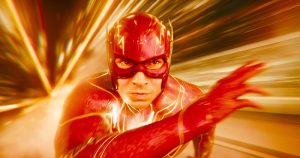
I intended to write this before chaperoning a school trip to Germany but, well, life got in the way. Just prior to departing, I made sure to wach the earliest screening of The Flash to avoid spoilers. I figured it would generate conversation and maybe controversy. What I did not count on was it crashing and buring in the spectacular way it has. As I write this, the global box office is at $218,971,000, far from the approximately $700 million it will ned to cover costs. Lots of learned industry publications, including The Washington Post, have examined why this big budget movie failed to connect and all told, they pretty much identified the major issues. Nothing new from me on that topic.
Was it good? Well, I came in with middling expectations and they were met. A good big screen experience with some winning performances, lovely visual touches, and a few feel-good fanboy moments. However, it did not stick the landing with the final image being both a joke and a chance to reset the audience from the last dregs of the Snyderverse to the James Gunn iteration of the DCU.
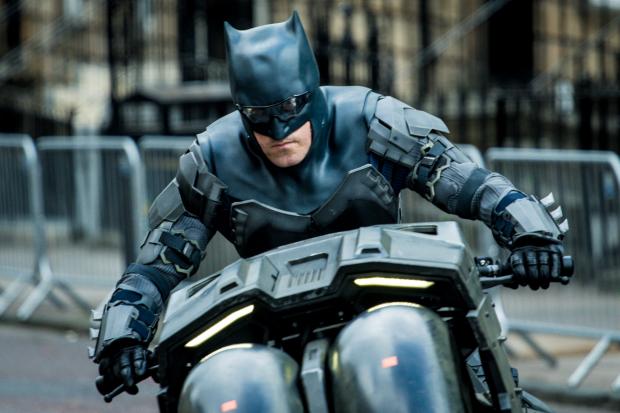
DIrector Andy Muschietti was challenged on several levels. First, how do you depict speed in a fresh way considering we’ve seen speedsters in other films and on television. Here, I think he did fine, coming up with something to set it apart, while still including aspects such as the need to feed the ever-present desire for calories. While many take issue with the quality of the SFX in his action set piece at the hospital, it was fine, if prolonged.
As goofy as Ezra Miller’s Barry Allen is, here he is also a more experienced hero, more comfortable in his skin. His clunky self-made costume has been replaced with something sleeker and more fitting a hero. The use of Batman (Ben Affleck), Alfred (Jeremy Irons), and Wonder Woman (Gal Gadot) firmly ground the heroes as a functiuoning Justice League. This is nicely contrasted with Barry being always late at work; and look, he has work colleagues. All good.

The impulsive idea of traveling back in time to prevent the death of his mother Nora (Maribel Verdú in a nice bit of casting) is too irresistible to avoid, even after Batman warns him of tampering with the past. And from there, we’re off.
Which brings us to the multiverse. Arguably, audiences have been primed to grasp the multiple realities concept since the “Mirror, Mirror” episode of Star Trek. More recently, for whatever reason, both DC and Marvel have leaned their film franchises into embracing the multiverse as a storytelling device. As a result, there have to be ways to differentiate them and here, the spaghetti analogy helps because over at Marvel, you change one thing, new branches spring forward. In the DCEU, it seems, there are ripples in space-time going in both directions. This nicely provides an explanation for how the new reality’s Bruce Wayne (Michael Keaton) is older and has been Batman far longer than the one Flash knew.
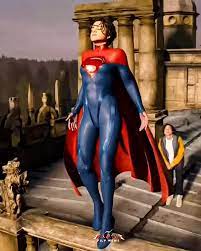
The story shows how the ripples play out, not just with a different Batman, but it’s a world without a Justice League, a world where Kal-El’s rocket didn’t deliver the infant to Kansas. And when Kara Zor-El’s (Sasha Calle) ship arrives, it’s in Russia where she is kept in chained isolation, deprived of the solar radiaiton to give her super-abilities. As a result, when General Zod (Michael Shannon) arrives to terraform Earth into New Krypton, Superman is not on hand to stop him.
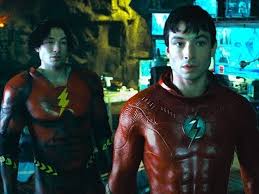
All well and good. But we have Barry Allen traveling back in time and interacting with the Barry of the new timeline, one where his mother’s tragedy and father’s arrest didn’t make him the hero he is. Instead, this is a callow youth who must be taught heroism by his other self. It’s played in equal doeses for drama and laughs and reminds us this movie is named after the Flash despite all the other heroic characters. So, when the chips are down, it will take two Flashes. an aged Batman, and inexperienced Supergirl to do what one Man of Steel could do in the proper timeline.
While the script, from Christina Hodson (based on a story from John Francis Daley, Jonathan Goldstein, and aJoby Harold) does well with the two Barrys, it does a disservice to the others. Keaton has his moments, but we never get to know how he went from Dark Knight to crazed hermit. Calle’s Supergirl has attitude but really is given no real characterization which seems to be wasting a talented actress and Shannon is right to criticitze how he was used, merely as someone to hit.
Then we step away from the immediate threat to Earth with a larger, existential threat as a time-trapped Barry has been driven crazy trying to revamp the multiverse and create the ideal world. We watch worlds crash one into the other with a series of fan service images including nice nods to the filmed media dating back to the 1950s. Still, it distracts, reducing the the importance of the main threat.
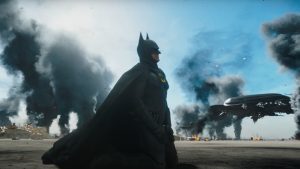
Once things seems to have been put to rights, it’s time for Barry to go home. Here, the character commits the same error his television counterpart made through most of his nine seasons: he repeats his mistakes and doesn’t show growth from experience. The one innocent act may save his father (Ron Livingston), but once again shuffles relaity leading to the cute appearance at the film’s end.
So, is the film of any consequence to the forthcoming DCU reboot? No. Because the film’s ending clearly states the reality we last see the Flash in, is not the same one we started with. The mid-credit sequence is a throwaway. The multiverse continues to exist so when the Gunnverse begins, we’ll just be on another iterartion of Earth with its heroes and villains. There, some will seem the same (see Amanda Waller and Peacemaker for starters) and should there eventally be a Flash, everyone says it will be Miller in the costume. I’ll wait and see about that.
I enjoyed the film (and the popcorn) but is it deserving of the superlatives people like Gunn and Stephen King heaped on it? No. It isn’t ideal on all the levels it needed to be. After all these years waiting for the film, tracing back to the aborted David S. Goyer 2005 version, this may be the sole entry in the franchise we’re likely to get. If that’s the case, then this ultimately failed to deliver.
#Tags: Alfred, Andy Muschietti, Batman, Ben Affleck, DC Comics, DCEU, DCU, Ezra Miller, Gal Gadot, General Zod, James Gunn, Jeremy Irons, Michael Kearton, Michael Shannon, Sasha Calle, Supergirl, The Flash, Wonder Woman
I loved the film. I gather that you weren’t a fan of the Zack Snyder DC films (“dregs”). I am, and I thought The Flash was a terrific ending to that film cycle (which, in my own head canon, is Man of Steel, BvS, Justice League (Director’s Cut), Wonder Woman, and The Flash). I thought that bringing back Zod gave that overarching story a nice bit of narrative symmetry by ending it exactly where it began.
I also thought that, in contrast to Spider-Man: No Way Home (the closest MCU analog, and which I thought was cringe-inducingly terrible), The Flash had an honest-to-goodness actual story, and wasn’t just an excuse for cheap nostalgia mongering (I thought that Into/Across the Spider-verse was better than both Flash and No Way Home).
I also wasn’t bothered by the characterization of Keaton’s Batman, Supergirl, or Zod. This was Barry’s story (or, more appropriately, Barrys’ story), and the other characters were supporting characters in service to that story. I think that to demand more from the characters is like criticizing The Empire Strikes Back for not giving us more depth and back story to Lando: He served his narrative purpose. The same with Keaton, Supergirl, and Zod. I think that all of the MCU solo movies have caused audiences to forget that supporting characters serve a narrative purpose, and aren’t all interesting enough (or worthy enough) to get their own fully developed arcs. I also personally felt that Keaton delivered more depth and resonance in his performance in this film than he did in either of the two Tim Burton films (and I really liked those films).
As someone who grew up in the ’80s with the deconstructionist takes on the DC characters (Miller’s Batman, Byrne’s Superman, Perez’s Wonder Woman, Grell’s Green Arrow, Truman’s Hawkworld, Chaykin’s Blackhawk, Moore and Gibbon’s Watchmen), this film arc (MoS, BvS, ZSJL, WW, FLSH) was the perfect realization of (and expansion of) those deconstructionist ideas presented during the height of the Jenette Kahn era (which, for me, was from about 1985 to 1991). They may not be for everyone, but they are nevertheless legitimate in their connection to those canonical comics tales (something which many critics of the Snyder-verse films (I’m not including you) try to deny). The Flash wasn’t the ending to the DCEU story that I personally would have wanted (I was hoping for a realization of the Darkseid story), but it was still satisfying in its own right.
I’m not really looking forward to the Gunn-verse (I found his GOTG and Suicide Squad films to be charmless, witless, and banal), but I’m fine with another approach being taken with these characters. I personally don’t think it will resonate with the audience (the Marvel audience is not the same as the DC audience (something which WB management repeatedly fails to understand), and the diametrically different audience reactions to the GOTG movies and The Suicide Squad perfectly illustrates this), but if the Snyder-verse was going to end, The Flash was a good way to end it.