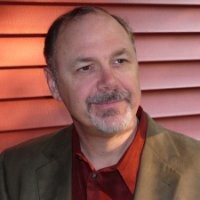
DC and I parted company in January 2006, and that spring, writer/editor Lee Nordling reached out to me. As part of The Pack, a group of freelancers he collaborated with, he’d begun working with Scott Mitchell Rosenberg’s Platinum Studios. He wanted to know if I was interested in doing some freelance editing for them, and I thought that sounded like fun. Who knew?
Platinum is still limping along in some form today, but back then, it was gearing up to be a player. Variety reported in 2004, “Platinum has a library of more than 1,000 comic book characters and stories from artists around the world. Other Platinum projects include sci-fi action-adventure Unique for Touchstone, about a man trapped between parallel worlds; David Goyer (Blade: Trinity) is attached to direct, and Michael Cooney (Identity) is scripting. Rosenberg will produce with David Heyman and Heyday Films. At Miramax, Rosenberg has set up Mal Chance, a romantic comedy-cum-martial arts actioner about a female assassin with a mob bounty on her head; at DreamWorks, Platinum has set up Italian cult comic Nathan Never.”
The only project you may have heard of was their Showtime series Jeremiah.
In 2005, they hired Brian Altounian, a Time Warner executive, as their chief operating officer. Rosenberg was serious about expanding the operation from comics to films.

Lee was the company’s executive editor, recruiting me, Brian Augustyn, and Sholly Fisch, among others, to edit the long list of internally generated properties. The internal creative people include Aaron Severson (VP of Story) and Meredith Berg (Story Editor). As Berg posts on LinkedIn, “I worked with the story department to create original ideas for comic books. I worked with writers and artists to develop their comic book ideas into published work. I worked with film and television writers, producers, and directors to bring the stories from comics to the screen. I was also active at comic book conventions to find new artists and writers.”
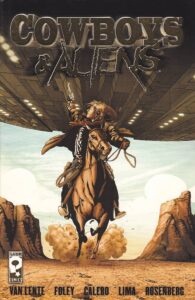
When I joined the outfit, they were high on the prospects for the graphic novel Cowboys & Aliens, which had already been optioned for film. Meanwhile, they had print and media staff — even a submissions editor.
Aaron explained that they were strong on the traditional three-act structure spread across four-issue miniseries, eventually to be collected.
While waiting for my first gig, Lee asked me to proofread Cowboys & Aliens on April 17, which proved to have a strong premise but lousy art and script (which may be one reason the film sucked).
I was offered Dark Forces to edit in May, an outside pitch they accepted. Lee was accommodating, letting me read what existed and deciding whether it met my interests. I began seeking a writer. By the 24th, I was offered their next graphic novel, Ghosting, already written by Fred Van Lente.
I began hunting for an artist and settled on Tom Grindberg. I discovered through our dealings that Platinum paid less than the current industry page rates. Worse, they wanted to own the original artwork, which was a nonstarter for most artists, including a veteran like Tom. We negotiated, and he finally accepted, but by early May, a DC writer told me that Tom had accepted an Ion fill-in, so of course, he quit on me. It took a few months before I found an artist I liked and would work for the rates. Kudos to Ron Marz, who kindly connected me to multiple international talents.

While that was happening, on June 1, I offered Dark Forces to Keith DeCandido. A day later, I agreed to edit Scott O. Brown’s Hunter. I accepted Delta Gene a week later, which I offered to Robert T. Jeschonek. In August, Bob recounted., “I remember being super excited about the opportunity to write a 3-issue, 88-page mini-series with the potential for development in other media. I dug into Platinum’s extensive story treatment, did some research online to expand it, and worked up a detailed outline for the project. The outline really fleshed out the story while hitting the structural beats and meeting Platinum’s requirements. In the end, though, my work was for nothing, as the project—and Platinum—sank. In the wake of this defeat, I mostly remember being deeply disappointed that everything I’d done had been totally wasted effort. I couldn’t even ‘scrape off the serial numbers’ and recycle the story, since it was based so heavily on Platinum’s treatment. Looking back now, I see, unfortunately, that it wasn’t an unusual outcome. I’ve worked on plenty of other projects since Delta Gene, putting in the same kind of effort—or more, even—only to have someone pull the plug for some reason or another. It’s just part and parcel of the life of a writer, or anyone working in a creative field. At least Platinum folded before Delta Gene went to full script or illustrated pages, which would have been even more tragic and wasteful.”
Return of the Wrath came the next day, which already had scripts. Still, the project never gelled and went nowhere. The day after, Grindberg quit. The week ended with me being assigned Rob Moran’s comedy Cupid Sparrow, which I immediately offered to Phil Foglio, who wisely turned it down.
As Keith’s sitcom approach to Dark Forces developed, I offered the art assignment to Gene Gonzales. He never got to design characters as Aaron and Meredith put Keith through the wringer over the script. Today, Gene has no recollection of the assignment.
As of June 17, I started on staff at Weekly World News but agreed to continue freelance editing because it was apparent none of these projects would be overly taxing. Lee and Aaron were fine with this.
So, of course, a day later, I was offered not one but two new projects: Blood Letters, written by David Rust, and ESPD to edit with my former officemate and housemate Barbara Kesel to write. And the day after, Julio Briha agreed to illustrate Ghosting.
As the weeks passed, Keith revised his premise and approach. Platinum asked for something else, and Keith was fired from the series on July 27. He recently recalled, “My main memory of the disaster that was Dark Forces was that the folks at Platinum were constantly focused on tropes and buzzwords and looking for the types of things that ‘belong’ in this type of story to the exclusion of being in any way, shape, or form interested in plot, story, and characterization. It was all about making it hip and happening.
“My ‘favorite’ note was objecting to the main character seeing a therapist. ‘That sounds like a rich New Yorker thing, seeing a shrink, unless there’s some specific trauma involved.’ That was when I knew we wouldn’t be on the same page, as that attitude is out of the 1950s.”
Two days later, I was relieved of the editorial assignment.
By August, Platinum finally began printing artboards for the artists, which was a plus for all concerned.
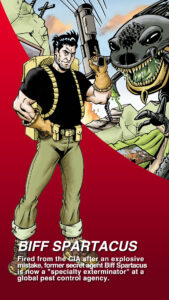
However, artist Julio Briha quit, and Luis Henrique agreed to draw Ghosting. Later in the month, Lee took ESPD and Blood Letters in favor of Biff Spartacus, written by Brian Joines and drawn by Tomás Morón and Miguel San Nicolas. Aaron described it to me: “It’s a comedy-action piece in the vein of Ghostbusters.” With that in mind, I recruited Gordon Purcell and Paul Fricke to handle the art.
Please note that I have been actively developing work since May, and very little has been written or drawn by this point.
Meanwhile, Platinum was making a lot of noise, including an article in The New York Times on September 20 promising digital comics and print. Animated trailers are also promised.
Brown’s Hunter was having script issues, so it was decided to move it to the company’s proposed “second wave,” set for 2008.
While working at WWN, my free time at home was frustrated by the constant editorial notes, reshuffling of work, and lack of getting anything done. Apparently, Rosenberg was also getting frustrated as he replaced Lee Nordling with Jim McLauchlin, who came in as editor-in-chief on November 14, something I read online before being told by Platinum.
Jim and I knew one another and got along just fine, but he admitted that the roster of freelance editors didn’t make sense to him and that he needed to bring everything in-house. We discussed a $1500 kill fee for all work done to date, and I settled for $1200.
In the wake of its departure, Ghosting was reduced to a miniseries with art by Charles Carvalho and Carlos Ferreira and released through Top Cow in December 2007. Blood Nation (Feb.–May 2007), illustrated by James Devlin, also saw print.
They were on the cutting edge of digital comics, acquiring DrunkDuck.com and WOWIO. Alas, the company imploded quickly. Only a few titles saw print, while they posted net losses of $4.3 million in 2006 and $5.1 million in 2007. Altounian left the firm and acquired the two digital companies in 2009. The Securities and Exchange Commission delisted them for failing to keep up its financial reports in 2012.
Platinum is still out there, limping with hopes and promises of a brighter tomorrow. Weirdly, I spent all that time and effort working on stuff that no one knew about and never saw the light of day.
#Tags: Aaron Severson, Barbara Kesel, Biff Spartacus, Blood Letters, Brian Altounian, Brian Joines, Cowboys & Aliens, Cupid Sparrow, Dark Forces, David Rust, Delta Gene, ESPD, Fred Van Lente, Gene Gonzalez, Ghosting, Gordon Purcell, Hunter, Jim McLaughlin, Julio Briha, Keith R.A. DeCandido, Lee Nordling, Luis Henrique, Meredith Berg, Miguel San Nicolas, Paul Fricke, Phil Foglio, Platinum Studios, Rob Moran, Ron Marz, Scott Mitchell Rosenberg, Scott O. Brown, Tom Grindberg, Tomás Morón, Top Cow