

The sale of Diamond Comic Distributors this week is another seismic shift in the comic book industry. I have already seen a former DC Comics colleague, Rich Johnson, announce his firing. Two other good frieds remain employed—for now.
It reminded me of my brief time working closely alongside Diamond while I was on staff at DC. On April 28, 1995, Diamond reportedly outbid Capital City Distribution for the exclusive distribution rights to DC Comics, following over the next few months with deals with Dark Horse Comics, Image Comics, and Valiant Comics, effectively making them the biggest distributor in America.
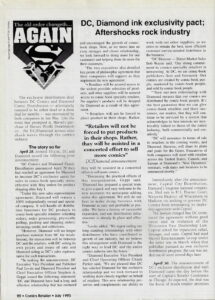
In 2020, on the 25th anniversary of the deal, John Jackson Miller wrote, “Capital City’s trade show in Chicago, which I attended, was about to get underway when the announcement was released. [Marvel] had already been sued in Wisconsin court under the state’s Fair Dealership Law to keep Marvel from taking its sales exclusive with Heroes World. (That case resulted in Marvel settling with Capital for undisclosed terms; the DC suit would result in Capital getting two extra months’ worth of DC comics.) Capital’s cofounder Milton Griepp made the news the focus of his ‘State of the Industry speech two days after the announcement (and 25 years ago today) at the trade show.”
It was a volatile period in the years following the B&W indie collapse and a shift in economics as the speculators fled for collectible phone cards. Marvel’s acquisition of Heroes World was a serious game changer, especially when it was clear to all they weren’t ready to scale up from regional to national distributor on the schedule they crafted.

That spring, I was called into a meeting where I was asked, I believe, by Paul to participate in the New Dynamics international tour of retailers being organized to introduce the new DC/Diamond partnership. The country was divided into regions, with a member or two from each company forming a team. At each regional retailer event, there would be a presentation on the partnership, along with a slideshow of what was coming from editorial to excite the somewhat nervous retailers. As the teams were being assembled, DC’s comptroller and head bean counter, Patrick Caldon, and Diamond’s President, Chuck Parker, were paired, but it became clear neither knew the books, talent, or content well enough to address those kinds of questions. So, I was asked to accompany “the suits” to the south.
(This was not the first time I had stepped in to help Marketing. In 1985, when the Dallas Fantasy Fair and Atlanta Fantasy Fair were opposite Chicago and San Diego, respectively, I was asked to be a one-man show managing a scaled-down booth and panel presence. That had some perks to be discussed at another time. In 1987, while they were between PR people, who handled the conventions as part of their portfolio, I was asked to help organize and run DC’s appearances at the San Diego Comic-Con, which also had its perks.)

For about a week, we three would visit several southern states, and I have to admit, after thirty years, I cannot recall all our stops. I know we stopped in Charlotte and Atlanta, but beyond that, I haven’t a clue. We’d arrive, offer a buffet breakfast, do the presentations, answer questions, and shmooze until dinner. More than a few retailers were relieved to have a fellow fan in their midst, someone who could answer their personal questions about our output, along with queries that might affect their business.
These guys spoke a whole other language and were discussing terms and situations that didn’t always make sense to me, or I should have been a party to, since they were dealing with things way beyond my pay grade. We got along very well, though, since Patrick and I had known one another for a decade by that time. Chuck was easy to chat with, although we came from very different worlds.
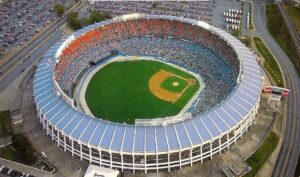
I do recall it straddling a weekend while we were in Atlanta and the three of us took in an Atlanta Braves game at what turned out to be the penultimate season at Fulton County Stadium.
It was certainly an enlightening experience, and I was always happy to help out the DC team. I don’t think I’ve seen Chuck more than once or twice since that week. He offered me tickets to any Baltimore Orioles game I wanted, and the one time I asked (for an Os-Yankees game), it got rained out. He is Diamond’s President, for now anyway, and I hope things turn out well for him.
Of course, I saw Patrick with great regularity until I departed the offices for good in 2006. He is thankfully enjoying a well-deserved retirement after decades of keeping our lights on.
#Tags: Atlanta Braves, Capity City, Chuck Parker, Comic Retailer, DC Comics, Diamond Comic Distribution, Fulton County Stadium, Heroes World, John Jackson Miller, Marvel Comics, Patrick Caldon, Paul Levitz'
(Not sure where else to put this, so I’ll just comment on the most recent post)
I really enjoyed your article on the 40th anniversary of Crisis on Infinite Earths in the latest issue of Back Issue. I was 11-years-old when the first issue of Crisis came out, and even then, I was really interested in how the sausage was made, so I devoured magazines like Amazing Heroes, CBG, and Comics Interview for behind-the-scenes stories. Your article took me back to those days.
You had a line in your article: “That made 1985 a very exciting year to work at DC.” Like I said, I was 11 when Crisis was released, so my “golden age” of comics is roughly 1985 to 1990-ish. So much good stuff was published during those years, especially at DC. Getting back to the line I quoted above, did you and the others at DC realize at the time just how special things were as they were happening? Did it feel meaningfully different from what came before and what came after (following the mid-1990s crash)? Or was it just another day at work for most of the staff? I often wonder if my affection for the work produced during those years is colored by nostalgia. It’s often said that the best music ever recorded is whatever was released when you were 14-years-old. And as I was that age during the period I mentioned above, I wonder if that’s why I like the comics of that time so much. But then I periodically go back and read the work in collected editions and I think (for the most part) the work still holds up really, really well. I just wonder if those of you on the front lines at the time feel the same way.
I know that there’s been a lot of revisionist history in the years since Crisis (which you alluded to in your article) that suggests that, since the effects of Crisis didn’t remain in place, that somehow that deems the effort a failure. I disagree. I love these characters, but I also recognize that they have finite potential. At some point that potential becomes exhausted and it makes sense to hit the reset button and tell the stories from a completely different angle, unburdened by the weight of years of continuity (one of the reasons I never fully warmed to Marvel as a teenager was because of the long, unbroken continuity which I personally found to be off-putting and impenetrable). I agree with your quote from Marv Wolfman that every generation deserves their own versions of these characters, which is why I cringe whenever I see the company try to bring back the pre-Crisis multiverse again and again. Let it go and try something new. While it doesn’t appeal to me personally, if I were 14-years-old today I would *love* the new Absolute line of books that DC has been putting out. To me, hard reboots aren’t a bad thing. And not everything has to be for me.
(Also: I can’t stand the multiverse. I think too many writers used it as a crutch in the pre-Crisis years. And judging from the collective shrug that the Flash movie and most of the Marvel multiverse TV shows and movies are getting, I think most audiences don’t like the multiverse either.)
Without even realizing that it was the 40th anniversary, I re-read the Crisis Deluxe Edition late last year. It was probably my first cover-to-cover reading of the story since 1985. And I think it…sort of holds up as a story. The artwork is amazing (Crisis, History of the DC Universe, and the Wonder Woman reboot were all George Perez at his absolute peak). But as a story, I think it suffers from a lack of a central protagonist to anchor the spine of the narrative to. I’d be curious if having a central protagonist was ever considered as the team was plotting the series.
All that said, I still love Crisis, even with all its imperfections. The artwork is beautiful, and the story is sprawling and cinematic. But even more so, I love Crisis for what it ushered in afterward (which is what it was designed to do after all). Going back to Marv’s quote above, the post-Crisis reboots of these characters were *my* versions of these characters. Byrne’s Superman. Miller and Mazzucchelli’s Batman. Perez’s Wonder Woman. Thomas and Mandrake’s Shazam (despite the side eye you gave that series in your article, I still love it). Grell’s Green Arrow. Chaykin’s Blackhawk. O’Neil and Cowan’s Question. Gaiman and McKean’s Black Orchid. Truman’s Hawkworld. Cavalieri and Staton’s Huntress. Bruning and Kubert’s Adam Strange. Chaykin and JLGL’s Twilight. These are the gold standard versions of these characters for me. And if it hadn’t been for Crisis, it’s likely that none of them would have come to be.
So I thank you and Marv and George and Jerry and Dick and everyone else who worked on it. And thank you for all of the insights you provided in your article.
Hi Daniel. You’re more than welcome. We knew we were riding a high that negan in 1984, more or less, and lasted until the death of Superman in 1992 (give or take).